
Sunday Sampler #2
Online workshop announcement, a list of things to read...

This weeks newsletter is heavy on the reading. I think we all probably need to be reading/learning a lot more, specifically things that go beyond captions, hot takes, or slideshow infographics on those evil apps. As usual I’d love to hear your thoughts on anything you find here.
THE LAND IS EVERYTHING TO US: An ONLINE learning series I am offering via Wendy’s Subway for 4(!) Sunday sessions starting November 16th, until December 7th (12-1:30 PM EST). There are only a few slots left, so if you want to learn with me please sign up ASAP. And just to be clear I receive a very modest honorarium regardless of how many participants there are. I am not promoting this because the sign ups have any bearing on my pay, but because I just so badly want people to come learn with me/together for the sake of our cause. I am grateful for the people at Wendy’s Subway who reached out to ask if I’d like to teach A workshop and humored me by agreeing to host a whole series of 4…one session wouldn’t be enough to even begin to scratch the surface of these topics. I truly hope that everyone that joins will leave with a more thorough structural understanding of how this all is tied together, one that they can then go out into the world and proliferate with justifiable confidence.
Anyone who has been with me on this ride for longer than the last two years knows I have been beating this drum for almost a decade, that I have utilized every medium available to me (dinners, essays, photos, published works, videos, rants, research, workshops…lmk if you have more ideas ha) to get my points across to as wide of an audience as possible. It really doesn’t ever feel like enough, especially when it becomes painfully obvious that most people (many Palestinians included) do not seem to have anything beyond a superficial understanding of the role “food” plays in zionist settler colonialism and occupation of Palestine. No, it is not simply about who “owns” or “invented” falafel or hummus, or even just that our food has been “stolen”. It is far worse than that.
Enough of the sound bite sensationalism found in instagram reels that distracts from the depth of the real issues that are killing us every moment. I am starting to feel desperate for people claiming to be earnestly engaged with our struggle to truly grasp the intricacies of food, land, plants, identity, and health in our context (beyond the aforementioned superficialities/ romanticization/ self-orientalizing and nostalgic content), and how those elements have been violently interacted with by colonizers to ethnically cleanse us for 100 years. This also goes for Palestinians who think that they know everything simply because they are Palestinian, which in my opinion, is liberalism in action. I care more about your principles and how you enact them, the education you have sought and how you use it to think critically, than I do about identity being weaponized to excuse one’s ignorance, arrogance, or bad political analysis and example. I have been recently saddened by seeing Palestinians who present themselves as working in service of the land, also collaborating with the same normalizers, zionists, and settlers who have contributed to both the degradation of the land but the suffering of our people. How can we claim to be defending the land when we are in collaboration with the ones who sell us out, and then also signal to others that this is acceptable behavior? Hopefully we will touch on some of these dynamics, including the ways class is implicated in every aspect of our struggle, in the sessions.
There are deeply sadistic levels to this violence and none of it is happenstance, either in origin or the symptoms it produces. In my opinion it should be a prerequisite to understand these issues to engage with our struggle at all, as they are at the core of it. As the title of this session says: The Land Is Everything To Us.
Allow me to quote myself from this 2024 post on LAND DAY:
For me, for us, liberation is our land. Not in the sense of borders, passports, ID cards and nationalities as dictated by the current global conditions of control demanded by capitalist society—but in its essence, meaning, sense of belonging, mutual reciprocity and responsibility, the connection between those who live on and with it, as they always have, as countless generations before did.
We, as a collective, have always been in deep relationship with our land, long before violent settler colonialism strengthened our resolve and steadfastness, long before flags and icons became the reductive symbology with which we perceive the intimacy between humans and the lands that hold them. Long before the path to martyrdom became the way of life for so many of our relatives. Palestine is the olive trees, it is the sanasil that striate the hills, it is the forests we have never been allowed to wander through, though we know they exist. We have the songs, we have heard the stories, we have seen the pictures. Palestine is the sea in which we cannot swim. Prior to the arrival of the british colonizers, literacy hovered at around 3%, for the simple reason that the language our people were fluent in, wasn’t found in books, it couldn’t be read anywhere other than in the bark of the madrone, the tracks of the hyena, the water worn stone in the crevices of the wadi. It held, and still holds, an intelligence and a wisdom in languages that can only be passed down by doing, by telling, by teaching, by living within, by sharing—through love. Palestine is the wind and all the scents it carries with it, the dusty kiss of fig leaves, lingering velvet on my nose, but also the carcass of a dead dog in the neighbors orchard, that no one wants to deal with. Palestine is the sun’s reflection off of white stones carved out of its’ own body to build our homes.
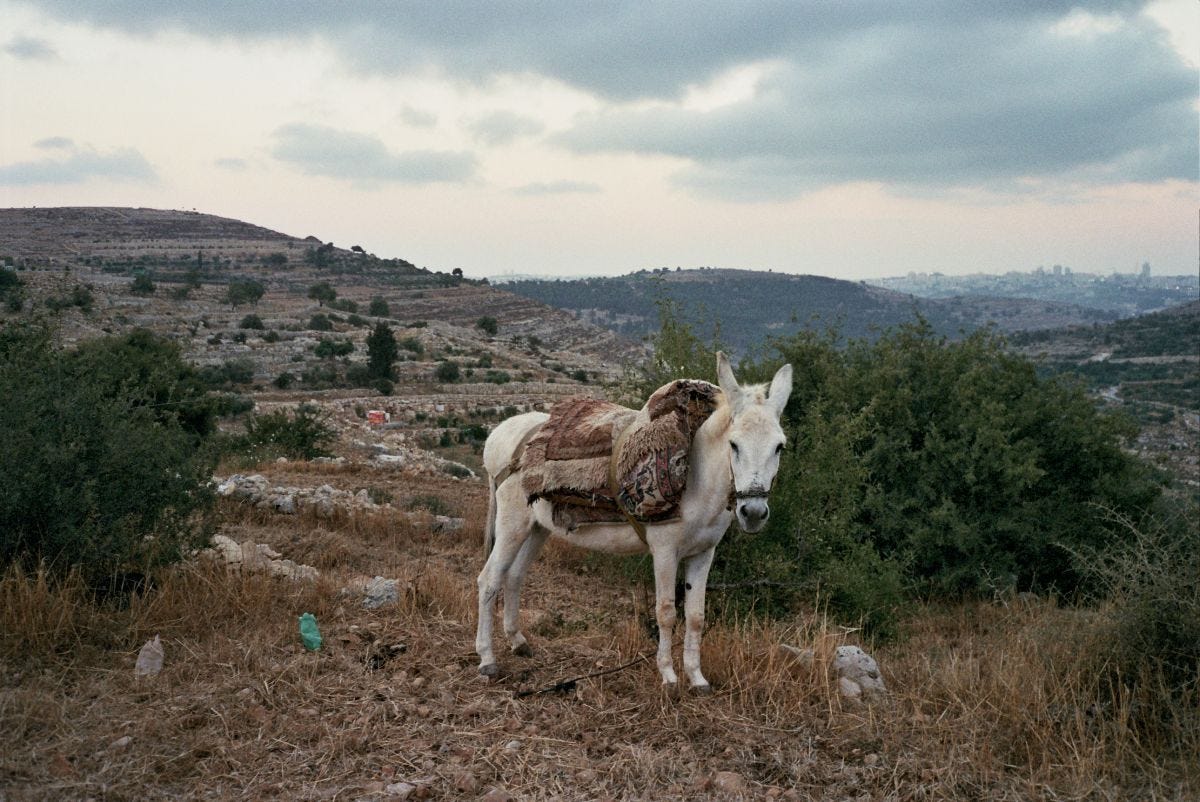
The land dies without the love of those it has nurtured—ecosystems tumble into chaos and inertia, seasonal streams dry up with finality, the plants stop returning, birdsongs left unheard by the leaves that came to know their words after a thousand years of listening, the trees forget to flower—not so long ago that the fellaheen were still tying strips of blessings in their woven branches. It was only a few months ago that the olives were left to rot off their stems as Gaza was shrouded with white phosphorous, and the ones that have long cared for their beloved trees were left to rot under the rubble of the lives they had managed to build despite almost 2 decades of globally ignored siege. Who remains to run the presses? Are there any donkeys left to pull the carts of harvested fruit? How many trees were doomed to become firewood, months ago? There will be no oil until next fall’s harvest, and even then…inshallah.
Each one, teach one. xx
If you have read this far and are not yet a paid subscriber, I really think you should change that :). If you don’t want to/can’t to but still want to materially support me in continuing this work you can paypal (amannya@gmail.com) or venmo me (@Buppybillow)…(without any notes or emojis that relate to palestine, please). Thank you to everyone who has ever/continues to support me and my ability to do the work that I do, I appreciate you all so much.